Why Does My Dog Bark at Other Dogs on Walks?
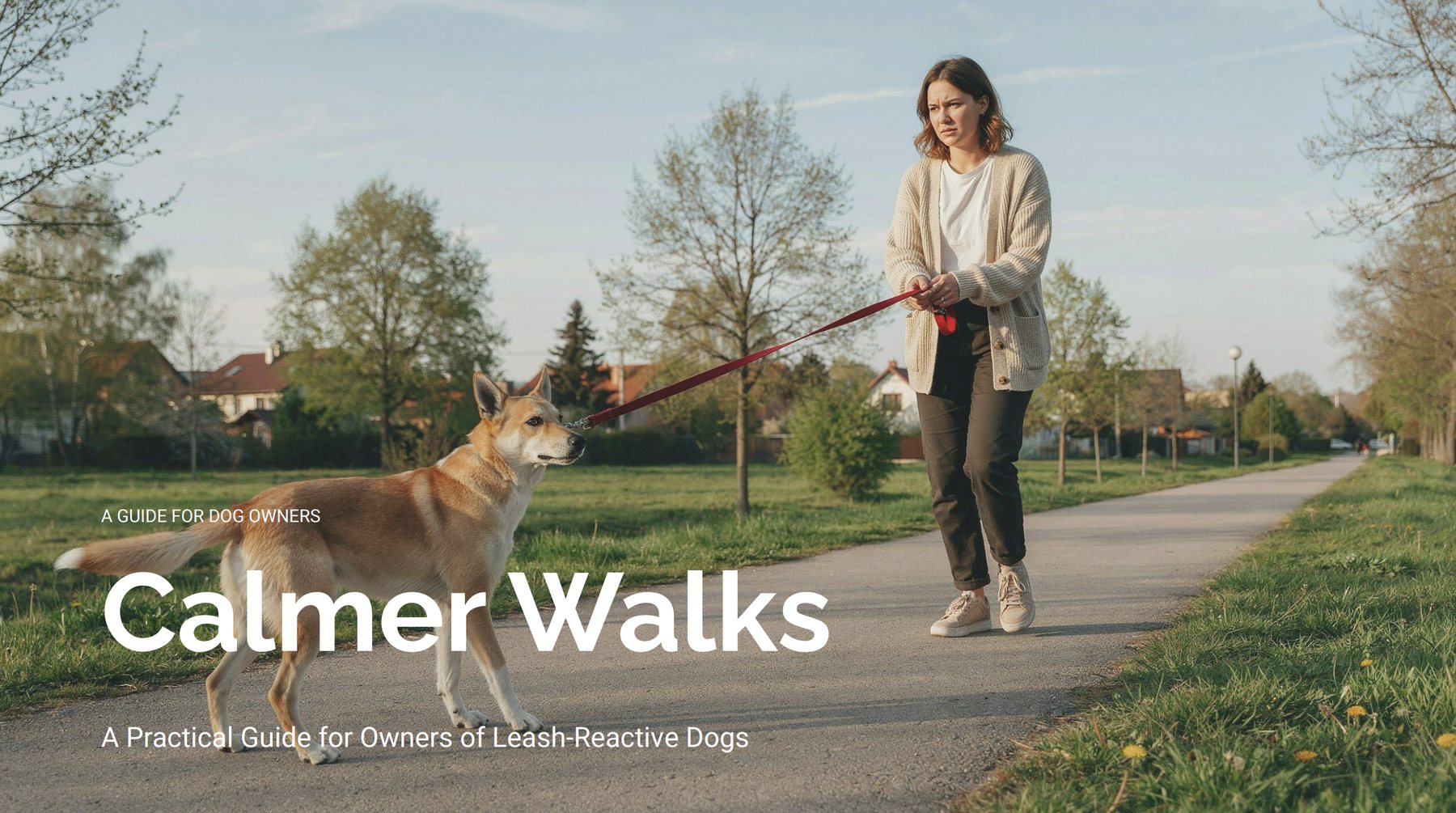
If your dog explodes into barking and lunging the moment another dog comes into view, it can feel embarrassing, exhausting, and confusing — especially if it happens on almost every walk. This is one of the most common issues dog owners deal with, and on its own, it's rarely a sign that your dog is "aggressive" or poorly trained. It's usually a sign that something about the situation feels difficult for them, and that there's a clearer way to understand what's going on.
A description, not a diagnosis
"Reactive" describes behaviour you can observe from the outside — barking, lunging, freezing, growling, or intense fixation on another dog. It isn't a diagnosis, and it doesn't automatically mean a dog is dangerous or that the two dogs would fight if they ever met off-leash. Two dogs can look almost identical in the moment they react, while the reasons underneath are completely different.
The behaviour you see is the end of a chain, not the start of one. A trigger appears → your dog notices it and has an emotional response → their body activates physically (heart rate, adrenaline, muscle tension) → they behave (barking, lunging, freezing) → something happens as a result → and your dog learns from that outcome. Barking is usually the visible tip of something that started a few seconds — or a few hours — earlier.
Why barking doesn't automatically mean aggression
It's easy to assume that a dog barking and lunging toward another dog wants to fight. Sometimes that's part of the picture. Far more often, the barking is a way of communicating "I need more space" or "I can't cope with this right now" — a request, not a threat display in the way it's often read. Treating every reactive dog as if they're one step from a bite tends to make owners more anxious on walks, which in turn can make the dog more tense too.
The most common underlying causes
From a distance, barking at another dog can look the same regardless of what's actually driving it. A few of the most common explanations, often overlapping:
Fear
Your dog is trying to create distance from something that feels unsafe. Barking and lunging are ways of saying "stay back" — not an invitation to come closer or fight. A fearful dog who successfully makes the other dog (or its owner) move away has just been reinforced for barking, which is part of why the behaviour can persist even when it looks dramatic.
Barrier frustration
Some dogs are genuinely social and want to approach — but the leash prevents it. That blocked social intent can come out looking a lot like aggression, even though the underlying motivation is closer to excitement than fear. This is common in dogs who are relaxed and friendly with other dogs off-leash but struggle on a lead.
Over-arousal
High excitement — rather than fear — can also produce barking, spinning, and pulling. It's driven by over-stimulation: too much happening, too quickly, for your dog to process calmly. A dog in this state often isn't scared of the other dog at all; they're simply flooded.
Pain or discomfort
A dog who is in physical discomfort, even mild or intermittent, may have a lower overall tolerance for stress and react more intensely than they otherwise would. If reactivity appeared suddenly, has worsened without an obvious reason, or shows up alongside other changes in behaviour, a veterinary check is a reasonable first step before assuming it's "just" a training issue.
What's happening before the bark
By the time your dog is barking, they've usually already been communicating for a little while. Early signals — a sudden freeze, a closed mouth, ears pinned back or pushed forward, weight shifted away from the trigger, a stiff or tucked tail, fixated staring — tend to show up first, often just a second or two before the louder reaction. Learning to notice these earlier signals is one of the most useful skills an owner can build, because it gives you time to act before your dog feels like barking is their only option.
Threshold: the concept that ties it all together
Most of what determines whether a walk goes smoothly or falls apart comes down to a single idea: threshold. Below threshold, your dog can notice another dog, take a treat, respond to their name, and make choices. Over threshold, none of that is reliably available — they're reacting on instinct rather than thinking clearly.
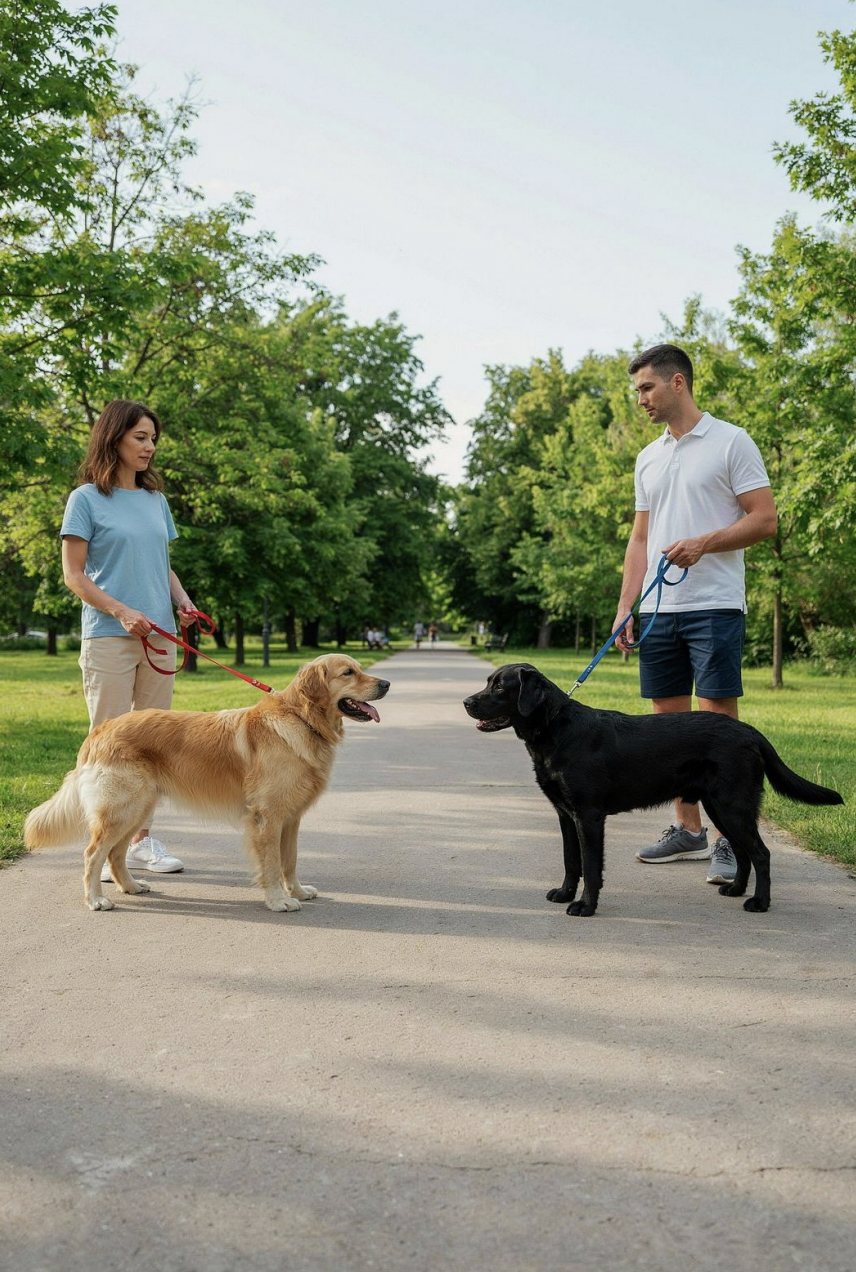
It can help to think in three rough zones: a green zone where your dog is comfortable and aware, a yellow zone where they've noticed a trigger but can still engage with you, and a red zone where they've gone over threshold and are reacting. The goal of most training exercises is to work right at the edge of the yellow zone — close enough that your dog notices the trigger, far enough that they stay thinking. We go into this in far more depth in Reactive Dog Threshold: How to Know When Your Dog Is Too Close.
Why distance is the tool that works first
Increasing distance from a trigger is usually the fastest, most reliable way to bring a dog back under threshold, which is why it's the tool most owners reach for. But distance isn't the only factor. How fast another dog is moving, whether it's approaching directly, how long it stays in view, and how many other things are happening at once — traffic, other people, noise — all affect how "big" that dog feels to yours, sometimes more than raw distance does. A dog fifteen metres away and moving fast can be harder than a dog five metres away and standing still.
What to actually do when another dog appears
In the moment, a few practical options tend to help more than trying to "correct" the barking:
- Increase distance first. Turn, cross the street, or move behind a parked car or hedge if one is available. Space is almost always the fastest way to bring your dog back under threshold.
- Redirect attention before they go over threshold. A cue your dog already knows well, paired with a high-value treat, can help them re-engage with you instead of fixating.
- Avoid pulling straight back on the leash. A sudden tight leash can add frustration or tension on top of whatever your dog is already feeling.
- Let them recover before continuing. If your dog does go over threshold, give them a few calm minutes before asking anything else of them.
Punishing the barking itself — a sharp leash correction, shouting, or a spray bottle — doesn't address why your dog is barking. It adds a second unpleasant thing on top of a trigger they already found difficult, which can make the trigger feel worse over time and can suppress the early warning signals you actually rely on to see trouble coming.
Why some walks are harder than others
Owners often notice that their dog handles the exact same situation calmly on some days and explosively on others. Trainers commonly describe this using the term trigger stacking — the idea that several smaller stressful events earlier in the day can add up, so a trigger that's usually manageable tips a dog over threshold more easily. It's a useful, practical way of thinking about a hard day rather than a precise scientific measurement. We unpack it fully in Trigger Stacking in Dogs: Why Your Dog Suddenly Reacts More Than Usual.
Tracking triggers and recovery
Because reactivity can vary so much day to day, patterns are often much easier to see on paper than from memory. Noting what your dog reacted to, roughly how far away it was, and how quickly they recovered afterward — even briefly, after a handful of walks — tends to reveal things that are hard to notice in the moment. Our free Reactive Dog Trigger Tracker is built for exactly this.
When professional support may be appropriate
Many dogs improve significantly with consistent management and reward-based training at home. That said, an individualised assessment from a qualified, force-free behaviour professional or veterinarian is worth pursuing if your dog has a bite history, if the reactivity involves serious aggression, if it appeared suddenly, or if you're not seeing any progress despite consistent effort. There's no shame in getting a second, trained set of eyes on your specific situation.
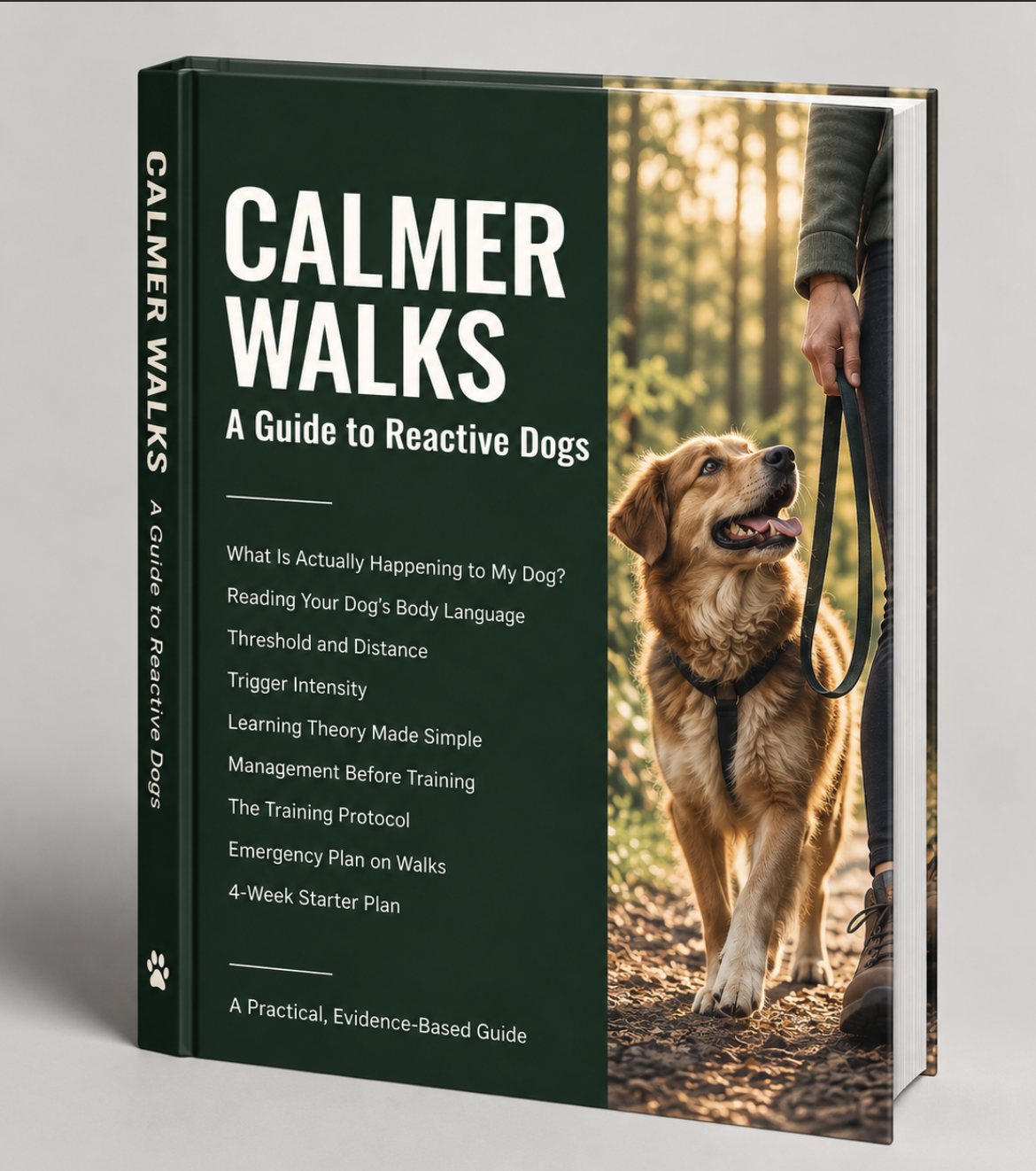
Want the complete framework? Calmer Walks brings body language, threshold, distance, trigger intensity, management, and a step-by-step training protocol together in one practical guide. Explore the Guide →
Sources & further reading
This article draws on published, reward-based behavioural science and position statements from recognised veterinary and animal-behaviour organisations, including the American Veterinary Society of Animal Behavior (AVSAB) and the ASPCA, paraphrased and explained in plain language rather than quoted directly.
This article is educational information, not a diagnosis. If your dog has a bite history or the reactivity involves serious aggression, speak with a vet or a qualified, force-free behaviour professional.
The guide
Want the full framework?
Calmer Walks walks through the complete picture — the model behind reactive behaviour, how to read your dog's body language, threshold work, and a step-by-step training protocol.
Explore the Guide